
From the start of the pandemic many scientists around the world have been working tirelessly on finding methods to combat the virus. I have had the opportunity to visit a small team in the department of Biochemistry at Cambridge University to understand the methods and processes they use when tackling a virus.
Five scientists have volunteered their time and incredible knowledge to fight the virus and have recently seen some encouraging results.
To understand their process, we must first understand the virus itself. The Corona Virus is not a living organism, so it lacks the ability to replicate independently. Therefore, it uses living cells inside us to replicate itself. Below is a brief depiction of a virus cycle once it enters the body.
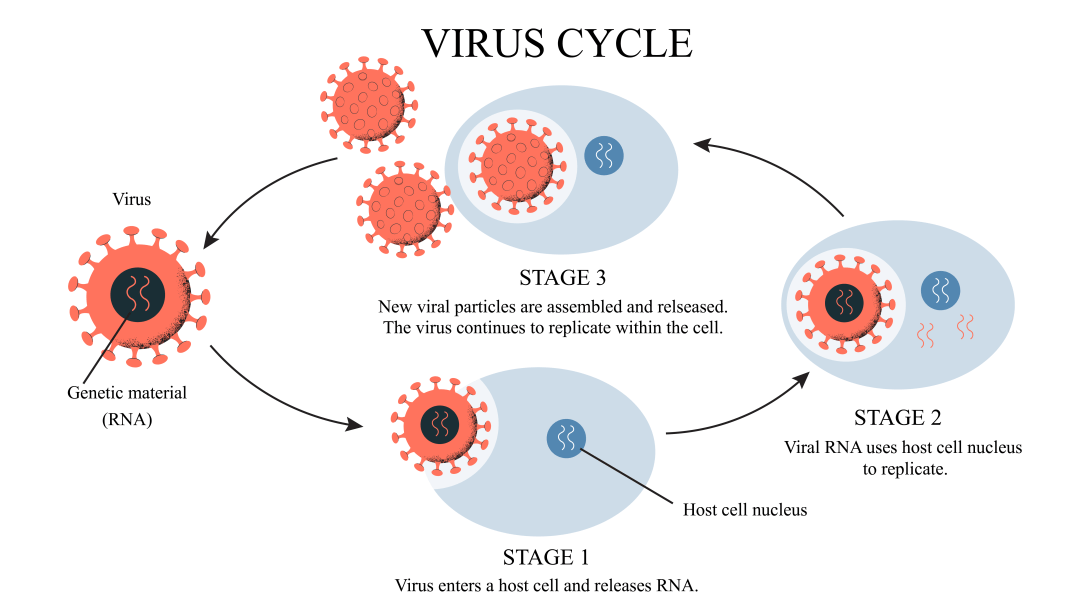
The scientists’ strategy to combat the virus is to stop it at stage 1, when the virus releases viral RNA (a molecule which converts information stored in DNA into proteins), this will prevent it from initiating viral protein synthesis and replication. To stop it at this point the scientists need the help of an enzyme (a molecule that speeds up the rate of a chemical reactions) our bodies already produce to cleave (cut) off critical parts of the RNA molecule to make it largely inactive.
We naturally have enzymes (RNase H) in our bodies that recognise and cleave a gapmer (coding sequence) in DNA and RNA hybrids (this is when a piece of RNA and DNA are attached).
The scientists have developed an artificial piece of DNA that will attach to the viral RNA, triggering the enzyme to cut the RNA and inhibit any chance of replication. The DNA has been modified to last a long time in our bodies and be actively taken up by cells to ensure lasting protection.
An understanding of similar viruses previously studied gives a good idea of the shape and structure of the current corona virus (2) RNA. This makes it easier to make synthetic DNA which can bind to it.
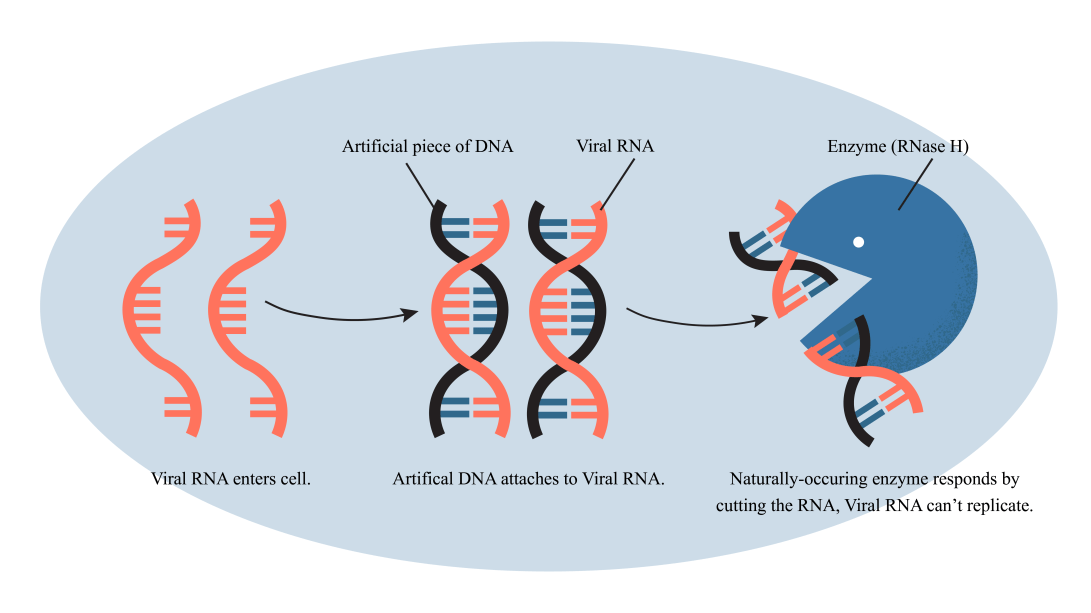
There are 5 stages of testing to see if this work will be completely successful.
- Stage 1, use purified viral RNA, artificial DNA and the enzyme inside a test tube to see if the DNA would successfully attach to the RNA and the enzyme would cut the RNA after attachment.
- Once stage 1 works the artificial DNA are tested for ability to target viral RNA in human cell cultures. Here they see whether the desired DNA-RNA interactions happen successfully inside human cells, and whether they are successfully cut by the enzyme found inside our cells. This step needs to be done as the conditions and volume of enzyme may vary inside cells compared to tests done in tubes. After stage 2 is successful the project will be continued by other experts in the field.
- Stage 3, a virus replication test is done, where cells are infected by the virus then treated with artificial DNA. The scientists assess the DNA’s effectiveness by comparing the quantity of viral replication by cells with and without artificial DNA.
- Stages 1, 2 and 3 are perfected until there is confidence and consistency in the results.
- Testing with people.
It’s a lengthy and complex process and so far, the team have accomplished stages 1 and 2, and are now trialing stage 3. Although Ben describes the group as a small cog in a big machine, we can see just how important they are in getting this project off the ground and running by setting a foundation for further steps. Overall, these scientists can be very proud to be part of this worldwide effort and what they have accomplished so far in these trying times.
 Francesca Luisi